Showing posts with label electrical machines. Show all posts

Wednesday, 26 October 2016

Doubly excited electromechanical system - Electrical Machines

Doubly excited electromechanical system

doubly excited magnetic system, doubly excited magnetic field system, doubly excited electro magnetic system, doubly excited electromechanical  system,
Doubly excited electromechanical system

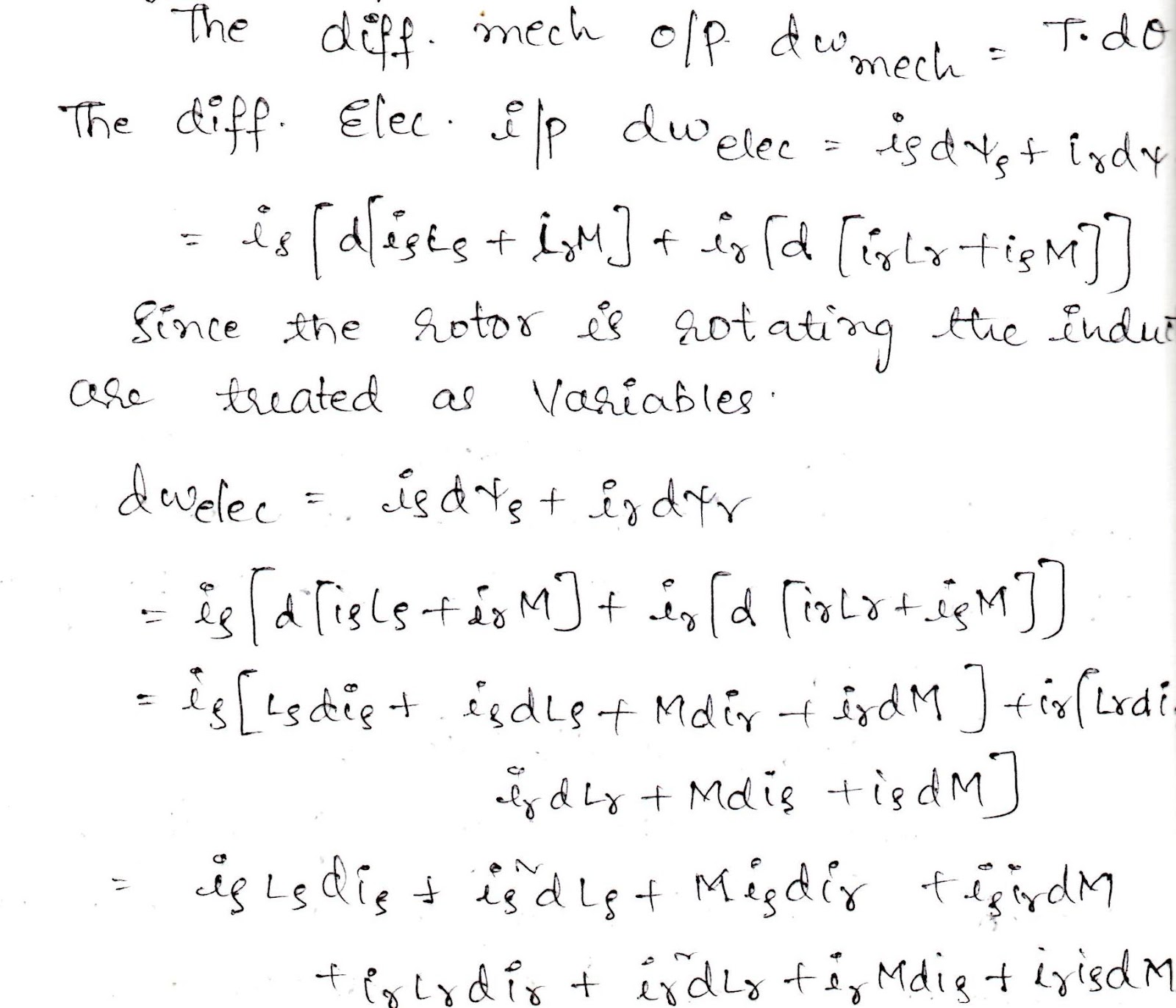
By keeping the rotor at a fixed position the switches S1 and S2 are closed. The differential electrical input to the system is equal to 


As long as the physical geometry of an electromagnetic system remains same the inductances also maintained constant.


Since the above system cannot produce any mechanical output. As the rotor is released, it starts rotating by torque T. 
Consider its rotation through a small angular displacement d(theta).
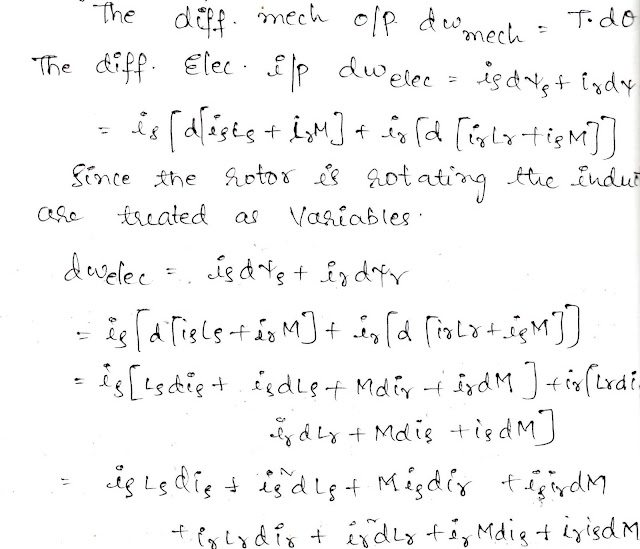

The torque developed also depends upon the angular derivatives of inductances along with stator and rotor currents.


For producing reluctance torque single excitation is sufficient but for getting mutual torque multi excitations are required.
The direction of reluctance torque cannot be reversed by reversing the excitation current whereas the mutual torque direction can be reversed either by reversing stator  current or rotor current but not both.

Singly excited electromechanical system - Electrical Machines

Singly excited electromechanical system


Singly excited electromagneticc system, Singly excited system, Singly excited magnetic system, Singly excited magnetic field system,
Singly excited electromechanical system

Excitation is the process by which energy (electrical or mechanical) is added to a system.The differential electrical input given to the system in small time dt is equal to


No electrical energy is absorbed by an electromagnetic system if its 'si' value is maintained constant. Since the above system cannot produce any mechanical output, the entire electrical input is stored in magnetic field as field energy.
  • There is no physical significance for co - energy. It is useful only for mathematical analysis.
  • Saturation is the property of a magnetic material by which its permeability decreases as the flux crosses a specified value.
 
  • The effect of airgap on electromagnetic system is 1. To linearize its magnetic characteristics i.e, no saturation. 2. It reduces the flux value for a given excitation current.

Electromechanical energy conversion - Electrical Machines

Electromechanical energy conversion process

Electro-mechanical energy conversion process is a reversible process.
Electrical machines are classified into two types based on the coupling field used.
1. Electromagnetic machines in which the coupling field is magnetic field.
2. Electrostatic machines in which coupling field is electrostatic field.

All our convention machines are electromagnetic machines due to the following advantages.
1. High energy storage capacity.
2. Safety operating conditions.

Electrostatic field is only used in electrometers to measure very high voltages.
Input = Output + losses + storage
Wim = Woe + Wlm + Wl fld+ Wle + Wsm + Ws fld 
Wl'm - Wlm - Wsm = Woe + Wle + Wl fld + Ws fld
Wmech = Welec + W fld
Above equation is the energy balance equation for generator.
Where, 
Wmech represents the net mechanical energy supplied
Welec is total electrical energy produced
Wfld is total energy absorbed by coupling field.
Welec = Wmech + Wfld
Above equation is the energy balance equation for motor.
Where,
Welec is the net electrical energy input.
Wmech is the total mechanical energy produced
Wfld is the total energy absorbed by field


Role of coupling magnetic field:

  • The coupling magnetic field in generators reacts with input mechanical energy source in terms of magnetic drag. So that the mechanical energy is absorbed and electrical energy is produced.
  • In motors, the coupling field reacts with input electrical energy source in terms of back emf so that electrical energy is absorbed and mechanical energy is produced. Hence magnetic drag and back emf are called electromechanical coupling terms.
  • In generators, as the electrical load increases magnetic drag increases.
  • In motors as the mechanical load increases the back emf decreases.
  • As long as the prime mover force is greater than magnetic drag, a machine behaves as a generator otherwise it becomes motor.
  • As long as a supply voltage is greater than back emf, the machine behaves as motor otherwise it acts as generator.